LLM Useful Functions Collection
Recommended posts: 【Python】 Python Useful Functions Collection, 【Algorithms】 Lecture 21. NLP and LLM
3. LLM agents
4. AI Scientist
1. NLP useful functions
⑴ A function that automatically translates a given sentence into English
! pip install --upgrade googletrans httpx httpcore deep_translator

def to_english (sentence):
    from deep_translator import GoogleTranslator
    translated = GoogleTranslator(source='auto', target='en').translate(sentence)
    return translated

print( to_english("나는 소년입니다.") )
# I am a boy.

print( to_english("단핵구") )
# monocytes
⑵ A function that automatically translates a given sentence into Korean
def to_korean (sentence):
    from deep_translator import GoogleTranslator
    translated = GoogleTranslator(source='auto', target='ko').translate(sentence)
    return translated

print( to_korean("I am a boy.") )
# 저는 남자입니다.
⑶ A function that automatically translates a given sentence into Japanese
def to_japanese (sentence):
    from deep_translator import GoogleTranslator
    translated = GoogleTranslator(source='auto', target='ja').translate(sentence)
    return translated

print( to_japanese("I am a boy.") )
# 私は男の子です。
⑷ Translation of a whole Markdown document
⑸ A function that turns an arbitrary variable-length natural language sentence into a 384-dimensional vector, considering its meaning (cf. CELLama)
from langchain.embeddings.sentence_transformer import SentenceTransformerEmbeddings
import numpy as np
from scipy.sparse import csr_matrix
import pandas as pd
from sklearn.neighbors import NearestNeighbors
import torch
from torch.utils.data import DataLoader, TensorDataset
from xgboost import XGBClassifier

def sentences_to_embedding(sentences):
    embedding_function = SentenceTransformerEmbeddings(model_name="all-MiniLM-L6-v2")
    db = embedding_function.embed_documents(sentences)
    emb_res = np.asarray(db)
    return emb_res


sentences = []
sentences.append("What is the meaning of: obsolete")
sentences.append("What is the meaning of: old-fashioned")
sentences.append("What is the meaning of: demagogue")
emb_res = sentences_to_embedding(sentences)
2. LLM applications
⑴ ollama.ai (free): Llama2/3/4, Phi-3, Mistral, Gemma, etc
⑵ GroqChat (free): Mixtral, Llama3, Gemma
⑶ OpenRouter (charged): Can utilize ChatGPT API, etc.
⑷ English–Korean translation using Llama2 (free)
import ollama

def english_to_korean(sentence):
    content = 'Translate "' + sentence + '" to Korean. Output only the translated sentence.'
    response = ollama.chat(model='llama2', messages=[
      {
        'role': 'user',
        'content': content,
      },
    ])
    return response['message']['content']

sentence = "I am a boy."
english_to_korean(sentence)
⑸ Determine whether a given sentence contains a chemical formula
import ollama

def is_chemical_formula(sentence):
    content = 'Please determine if "' + sentence + '" contains a chemical formula or not. If it is correct, answer "sure"; otherwise, "no".'
    response = ollama.chat(model='llama2', messages=[
      {
        'role': 'user',
        'content': content,
      },
    ])
    return response['message']['content']

sentence = "NH2OH is an amine."
result = is_chemical_formula(sentence)
print(result)
print('sure' in result.lower())

sentence = "I am a boy."
result = is_chemical_formula(sentence)
print(result)
print('sure' in result.lower())

### Output ###
'''
The term "NH2OH" does contain a chemical formula, so the answer is "yes" or "sure".
True
The statement "I am a boy" does not contain any chemical formulas, so the answer is "no".
False
'''
⑹ Determine whether a given noun is a proper noun or a common noun
import ollama

def is_proper_noun(noun):
    content = 'Please determine if "' + noun + '" is a proper noun or common noun. If it is a proper noun, answer "proper"; otherwise, "common".'
    response = ollama.chat(model='llama2', messages=[
      {
        'role': 'user',
        'content': content,
      },
    ])
    return response['message']['content']

sentence = "Pencil"
result = is_proper_noun(sentence)
print(result)
print('proper' in result.lower())

sentence = "Feynman"
result = is_proper_noun(sentence)
print(result)
print('proper' in result.lower())

### Output ###
'''
"Pencil" is a common noun. Therefore, the answer is "common".
False

"Feynman" is a proper noun. Therefore, the answer is "proper".
True
'''
⑺ OpenRouter
def openrouter_chat(messages, max_retries=6, timeout=120):
    url = "https://openrouter.ai/api/v1/chat/completions"
    headers = {
        "Authorization": f"Bearer {OPENROUTER_API_KEY}",
        "Content-Type": "application/json",
    }
    payload = {
        "model": MODEL,
        "temperature": 0,
        "messages": messages,
    }

    last_err = None
    for attempt in range(max_retries):
        try:
            r = requests.post(url, headers=headers, json=payload, timeout=timeout)
            if r.status_code == 200:
                data = r.json()
                return data["choices"][0]["message"]["content"]
            if r.status_code in (429, 500, 502, 503, 504):
                time.sleep(2 ** attempt)
                continue
            r.raise_for_status()
        except Exception as e:
            last_err = e
            time.sleep(2 ** attempt)

    raise RuntimeError(f"OpenRouter request failed after retries: {last_err}")

openrouter_chat([
    {"role": "user", "content": "What is the largest state in US?"}
])
3. LLM agents
⑴ Overview: 2026 is the year of LLM agents
⑵ OpenClaw (clawd.bot)
① An open-source project made by an independent developer, Peter Steinberger (steipete).
② Anthropic requested a name change due to trademark issues, so it was rebranded as Moltbot → OpenClaw.
⑶ Claude Code
① An LLM-based agentic coding tool made by Anthropic. The specific models are Haiku (fast), Sonnet (balanced) and Opus (high performance)
② How to set-up
○ Step 1. Install Antigravity
○ Step 2. Configure the initial settings upon first launch after installation (ref)
○ Step 3. Sign in with your Google account
○ Step 4. After accessing Antigravity, download three Python packages and Claude Code from the Marketplace
○ Step 5. Reopen Antigravity
○ Step 6. Connect the workspace
○ Step 7. Type claude in terminal and link google account
⑷ ChatGPT Pro
⑸ Google Ecosystem
① Model: Gemini, Gemma
② Research: NotebookLM
③ Design: Stitch (text → UI), Whisk (image visualization)
④ Text → Video: Veo, Google Vids
⑤ Coding: Antigravity (AI-based IDE), Jules (coding secretary)
⑥ Agent connecting the above tools: A2A, ADK
4. AI Scientist
⑴ The Horizon of Cognition and the Breakthrough Called AI
⑵ FunSearch
⑷ The AI Scientist (Sakana AI, Nature (2026))
⑹ The Virtual Lab (Youtube clip), The Virtual Biotech
⑺ AI-Descartes: Symbolic methods to rediscover Kepler’s third law
⑼ CodeScientist (Jansen et al., 2025)
⑽ AgentLab (Schmidgall et al., 2025)
⑾ Popper (Huang et al., 2025)
⑿ HypoBench (Liu et al., 2025)
⒀ AutoDiscovery: A model that generates creative hypotheses using an uncertainty (surprisal) measure based on the Beta distribution.
⒃ Kosmos
⒄ AI agent for drug discovery: CellType, Medea, Biomni, BioLab, OriGene, BioResearcher, STELLA, Agentomics, DrugSAGE
⒅ ChemCrow: chemical reasoning
⒆ Google Medical AI Ecosystem
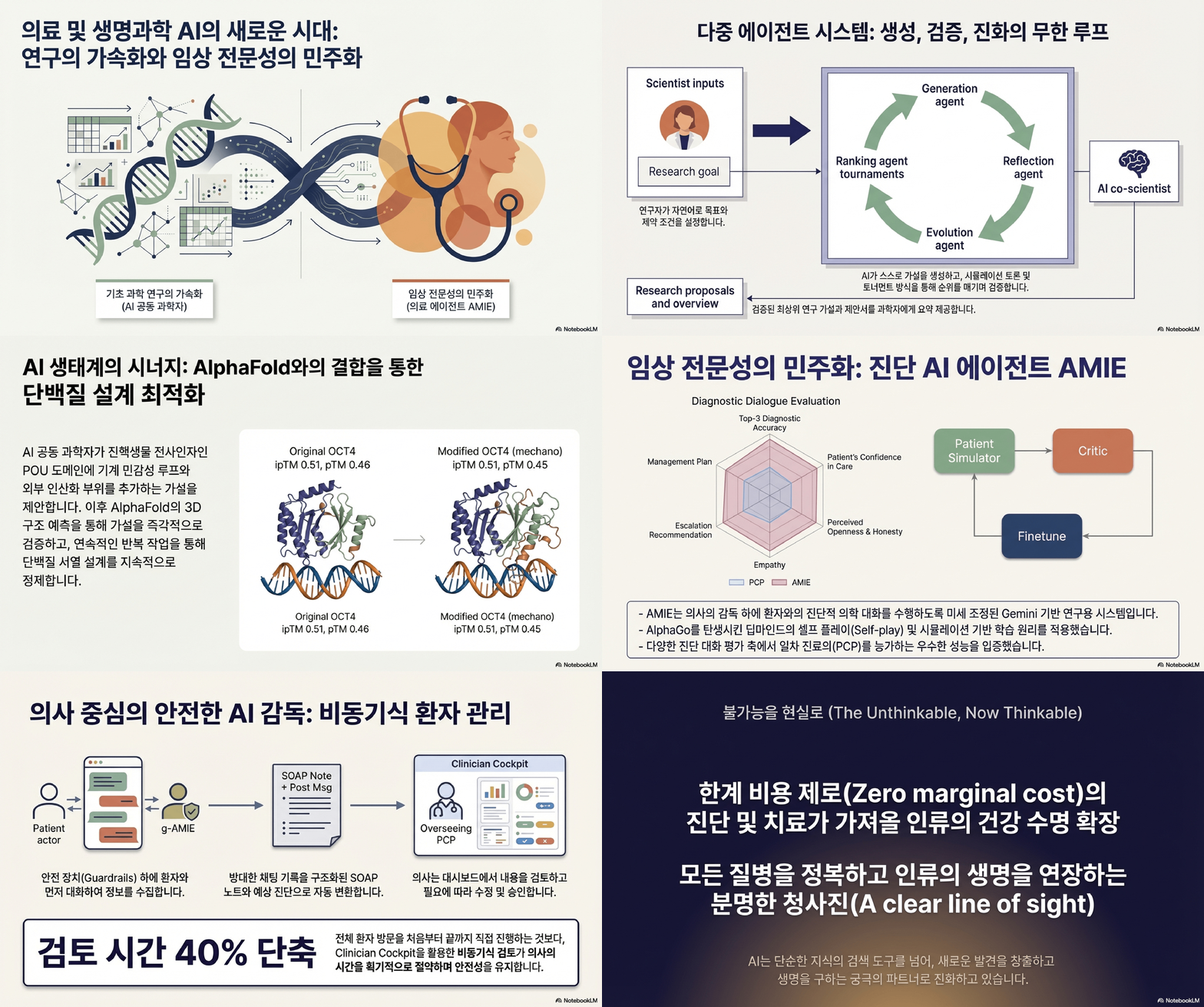
Figure 1. Google Medical AI Ecosystem
Input: 2024.02.10 13:34
Edited: 2026.01.29 00:43